This series of 3 epic mixes will not likely bring me any gigs, but you know I had to do it to ’em.
Predominantly Muslim music from Palestinians, Algerians, Moroccans, Syrians, Pakistani, Egyptians, Indians, Hausa, and Mongolians seamlessly mixed and juxtaposed as not only a tapestry of cultural cross pollination but a vision of future regional and cultural integration and unity.
Hypnotic and ecstatic Rhythmelodies in anticipation of increased West Asian, South Asian, South East Asian, East Asian, and African cooperation in matters of culture as well as economy, diplomacy, security. A sonic vision of a potential Asian Union as part of BRICS and rising multipolarity.
Futurism in Europe, the sonic avant garde, for the past half century or more, has proceeded on a total rejection of tradition. A cultural product of post-modernism and historical nihilism, the assumption rested upon is that the past is only shit and must be destroyed, wiped clean, to have tabula rasa – which is nothing but a fantasy, never mind the result of false understanding. So what we end up with at Atonal or Transmediale is an aversion to melody, a rejection of musicality, thousands of artists making bleeps, bloops, rigid, mechanical, inhuman forms, all of which mono-cultural, mono-rhythmic, and deeply pessimistic. But in the end, contemporary European electronic music, for all its rhetoric and pretence at “futurity”, fails to innovate, and is today in 2024 still near entirely reliant on innovations made 40+ years ago in Detroit and Dusseldorf — clubs are mostly still playing the exact same single untz untz rhythm pattern.
Futurism in the Global South is the opposite.
Firstly there is a formal revolution every few years in which new palettes, new rhythm patterns, and new dynamics emerge. In South Africa alone, we have seen radical new styles like Gqom and Amapiano within just the past decades.
Secondly, contemporary African electronic music is characterised by an EMBRACE of tradition, and not only those of the music makers themselves. In a heavy bass number, all of a suddent bursts of ecstatic deep jazz saxophone. Forms like Samba, Jamaican dancehall, etc., etc., are often alluded to and paid respect or re-interpreted. Angolan Kuduro often references Brazillian music as well as include Portugese influences; Amapiano encompasses near everything that has happened in not only African but also African American music during the past century, from jazz to house to hip hop and reggae, but done in unmistakeably South African ways.
The horrors unfolding around the world today in 2023 can be seen as the birth pangs of a new, more just and peaceful world to come.
Along with the final and real removal of colonial forces and increased cooperation with the multipolar world, we will see, are already seeing, authentic economic development, connection, and integration in and of the motherland. In the next decades to century or more, the humanist technologies of the Global South will thrive, multiply, and cross pollinate.
Now is a time to mourn, to struggle, as well as to celebrate the deep, world historic changes taking place, and what is to come.
We should dance not despite, not in trying to forget, the violence and sadness of current conflicts, but in the realisation that this is the end of the imperialist era; and in solidarity with the rise of multi-polarity, envisioning a bright future for the formerly colonised.
Since Fela’s voice is much cooler than mine, i have switched out my intro with his, and this mix originally made to promote BlackBox number 1 has grown into a proper NGOMA release – with a few changes and much new goodness including 2 wicked special edits – one of the Ethio classic by Mahmoud Ahmed (following a funktastic number by Berlin’s own Woima Collective), and another of a very unique cosmic disco track by the techno head Lego Welt’s Afrocentric alter ego Nacho Patrol. Old version of this mix can still be heard Rebootfm – 11-dj-zhao-blackbox-1-ngoma”>here.
This edition in the Ngoma Mix Series focuses on new 125 bpm African Electronic Dance Music. As i have argued in the “Real Roots of Kwaito” piece for This Is Africa, American and European Disco, House, and Hiphop were crucially influential in the beginning stages of development of post-Apartheid South African urban music, but since then SA House and Kwaito have matured and grown into its own skin, much more an extension of indigenous rhythm cultures than related to “Western” dance music. For example the beat patterns in these tracks are distinctly different: the constant off-beat high hats found in the US and Europe are almsot entirely absent; and with much more rich and developed rhythm elements and very different emphasis, this music should probably be thought of as simply new African dance music, with not much to do with what is traditionally known as “House” or “Techno” at all.
Made this for ultra cool international / art / architecture / concept / urbanism / fashion / music / design organization Platoon: United rhythms towards a borderless future: African House and European Acid, Hungarian Folk and Korean Pop, Cumbia Electro and Arabic Techno, Avant Jazz and Street Bass – international beats for dance floors and head space – against prejudice and xenophobia. DOWNLOAD:mediafire
during the past month or so these recent mash edits have been dropped on unsuspecting dancers Germany to Johannesburg, every time followed by lots of jumping and screaming.
Burundi drums so ill…
more coming soon 🙂
this is of course the all time classic from Nigeria, fixed with some additional bass and treble – rocks a modern dance floor like nobody’s business.
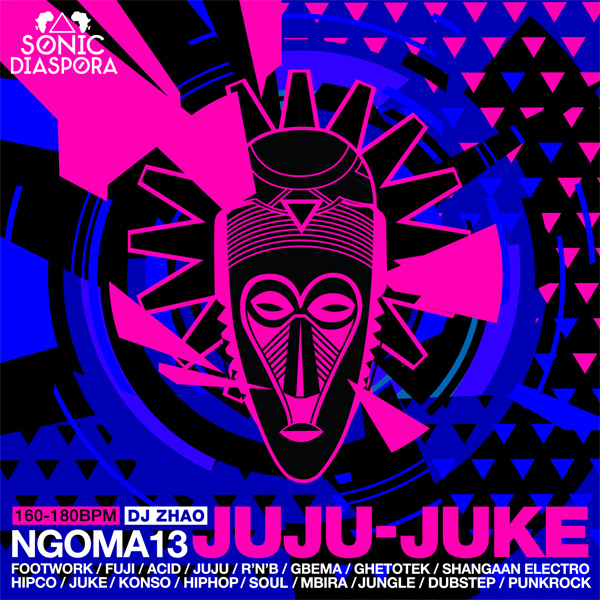
Ever since drums were banned on most slave plantations in N. America during the 1600s, after the masters discovering that the slaves organized revolts with their talking drums, the expression of poly-rhythms in N. American popular music has primarily been through use of the voice. This is the reason music in the US is typified by the simple 1-2 “dupple” rhythm, in contrast to more complex beat patterns in South-America or the Caribbean (which kept their drums). Thus the evolution of all subsequent Afro-North-American music was profoundly shaped, from Blues to Funk to Disco: kick on the 1, and snare on the 2; all the way down to the late 20th Century – complex poly-rhythms in hiphop is produced with rap, and the drums remain a skeletal, minimalistic boom-bap, as if just to mark time.
Now in the 21st Century a renewed sense of rhythmic complexity returns to Afro-North-American dance music in the form of Juke/Footwork in Chicago: interlocking 2s and 3s form intricate beat structures, unmistakeably related to many forms of percussion styles in the motherland (but still often keeping that N. American hard snare on the 2).
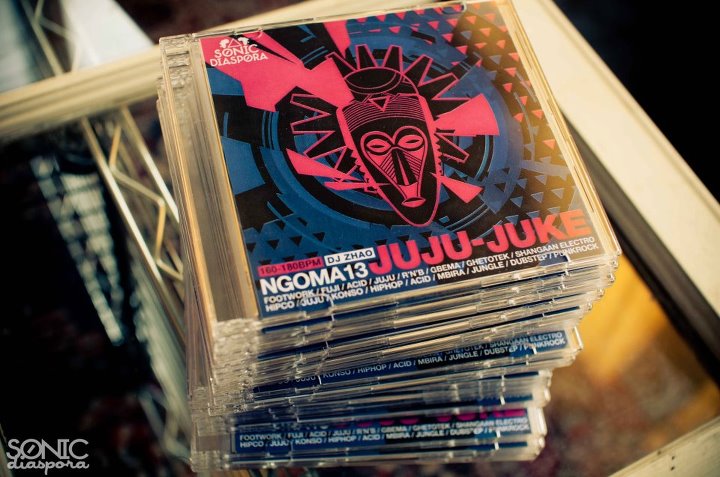
This NGOMA volume demonstrates this reconnection, after centuries of separation, between African tradition and Afro-Diaspora: between Nigerian Juju/Fuji music and Chicago Juke/Footwork, between Ethiopian dance styles and Detroit Ghetto-Tech, between Iberian trad-modern street sounds and American R’n’B/Pop, between Afro-Punk and Club Music, between Congolese Mbira workouts and Hiphop, between Ghanaian and Senegalese drumming and Urban Bass Pressure. Let us pump up the volume and remember the power and spirit of rhythm which survives every hardship, cruelty, and oppression, and rejoice in the timeless Music Of the Drums.
big thanks to Keith Jones for knowledge passing, Itzi Nallah, Sonic Diaspora and states side massive for making the Juju-Juke tour possible, my B-girls Jessi and Maya for support.Juju-Juke Tour kick off in Belgrade
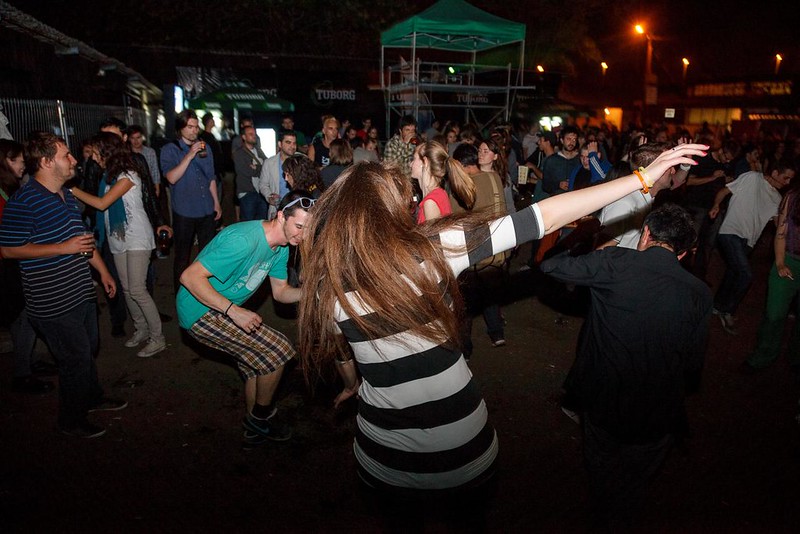
I have played this set a few times now during the Serbia, Germany, and US East Coast tour a few weeks ago, and crowds have gone completely BONKERS as the energy went straight through the roof: 500 screaming people and massive MOSH PIT at 3AM during Mikser Festival Belgrade; club crowd which refused to leave, clapping and hollering for 20 minutes after lights went up and sound was turned off at The Shrine Chicago. I guess the world is more than ready for 160 BPM Afro-Footwork pressure!!!
and here is that adrenaline fueled misanthropic juke edit of South African punk rockers Koos by itself (download and drop into your set if you are wo/man enough :D):






 NGOMA SOUND